BLOGS - PODCASTS - REVIEWS - INTERVIEWS
ABOUT WORK, LIFE AND CULTURE

You're the Boss
Book Review - You're the Boss by Sabina Nawaz
Paul Carter
2/8/20264 min read
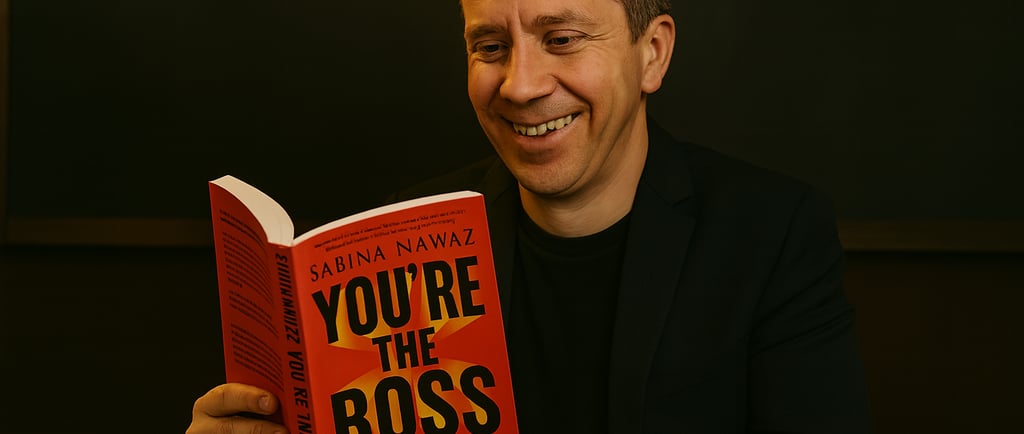
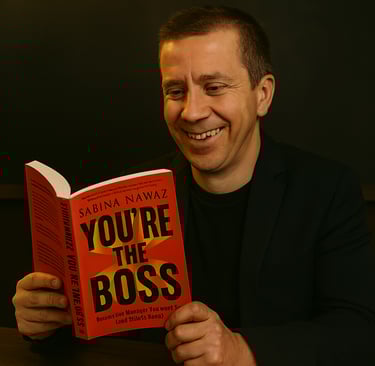
“Every job looks easy when you're not the one doing it. The price of success prevents us being able to pay it,” says elite Fortune 500 coach Sabina Nawaz in her book You’re the Boss. Don’t be fooled by the garish front cover with a WordArt style font that made me think I was reading a book from 1996.
She has been there and done it, working at Amazon, Google, Microsoft and the United Nations. However, this is not pages of name-dropping boasting. It is about the journey to management, what it takes to stay there and the shadow you cast. When explaining what creates bad bosses, Sabina talks about how “power shields us from seeing our missteps, while the increased pressure of high-level roles affects our ability to self-regulate our behaviour”.
“There are rarely bad bosses, only good people with the best of intentions and bad behaviours.” Maybe that is true, making me visualise a Channel 5 documentary of when good managers go bad and a panel of minor celebrities vote to keep or sack them. I jest, but I have been telling people at work how much I enjoyed this book, apart from the people on my coaching course as they might steal quotes from my magic book for our first assignment.
“We must mindfully navigate the combined forces of greater pressure and power – or else pressure will corrupt our actions and power will blind us to the impact of those actions.” It’s sad when people with limited power break the no arseholes policy, because they make their victims feel powerless. I don’t want to coach those people.
I want to be in the realms of power as that is where the drama, intrigue and conflict are. This book intersperses lived experience with testimonies and research to explore the critical truths and misconceptions about power, communication breakdowns, unmanaged pressure, your impact and efficiency and how to neutralise friction in teams.
I was introduced to the Immunity to Change Framework which examines how behaviours, hidden unconscious commitments and big assumptions of underlying, often false, beliefs that stop people achieving their goals. What I loved about the book was the deep mining into the multidimensional challenges of management. Something I know mainly from being managed, not the other side of the table.
“As the person in charge, all eyes are on us, and that triggers something deep in our encoded DNA. That “something” is almost always a fear of not being liked, of being wrong or not perfect, of being found out as an imposter, of being laughed at, criticized, or rendered irrelevant.” Work isn’t a popularity contest. If you are too nice, when you are assertive, it will create a seismic shock. Can you handle being unliked? Just remember it’s better to be respected than feared.
“As you rise in position and the distance between you and those who work for you increases, so does the pressure.” The book includes coaching consideration prompts like asking clients to identify casualties of success, if the desired change for your benefit will upset others.
I will be referring to the “Singular Story” concept in my assignments to describe a mental trap leaders fall into when they cling to one fixed interpretation of a situation, problem, or person and reject anything that challenges it. “When you signal you aren't interested in your team's input, you widen the power gap. This is exacerbated by the fact that those with less power will have a harder time standing up to a boss specially one who thinks they’re always right.”
As you get into this book the more it resonates, even if you’re not a business leader. “People are afraid if they open up to other perspectives, they have to agree with them. This cuts deep to the encoded survival we’re wired to protect. If our ideas get mucked with, does not our relevance, our unique position of excellence, wane?”
I hate people standing behind me. I find it difficult to share as I am scared of losing control and compromising. I can get drowned out in crowds. I get so annoyed when people can’t see what I can see. My way will work if you just believe in me. Forget it, I’ll do it myself. But will anyone care? Will anyone even notice?
Sabina’s “yeah, but” leadership statement is subtly different to “so, yeah” which often starts presentations and conversations. “Yeah, but” is a symptom of a deeper leadership issue. The linguistic cousin of the singular story which is the moment you stop being curious and start protecting your narrative. Being defensive under pressure, a need to be right and fear of losing authority.
Her recommended alternative of “Yeah, and” takes skill to execute correctly or you could sound like an annoying brat who says “why?” too many times. As if they were forced to watch Simon Sinek videos for two months and now regurgitated the introspective content. It’s about opening the door, rather than slamming it.
I will be referencing the Myth of Exceptional Behaviour which is a psychological shift from earning trust to assuming privilege. “Excellent is producing great work. Exceptional is believing the rules don’t apply to you.” Does that sound painfully familiar?
“Many corporations see the shiny outer layers – the key results – and don’t want to confront the truth behind them. There are plenty of yes-people who also insulate high-performing bosses from the truth tellers. No-one calls them out on their bad behaviour and everyone calls them a good leader, which they take to mean they can get away with anything, saying whatever and operating as they please.”
Do I have the courage to stand up to people like this or coach someone else to hold up the mirror? Time will tell. Maybe I have Superhero Syndrome “Only I can fix this. It’s faster if I do it myself. My team isn’t ready yet — I’ll just step in.”
It’s a mix of over-responsibility, over-functioning, and a subtle belief that you’re the only competent adult in the room.
Inspiration
What we talk about when we are working and living
© 2025. All rights reserved.