BLOGS - PODCASTS - REVIEWS - INTERVIEWS
ABOUT WORK, LIFE AND CULTURE

Why Work Matters
Please can you endorse my debut business book Why Work Matters
Paul Carter
1/17/20265 min read
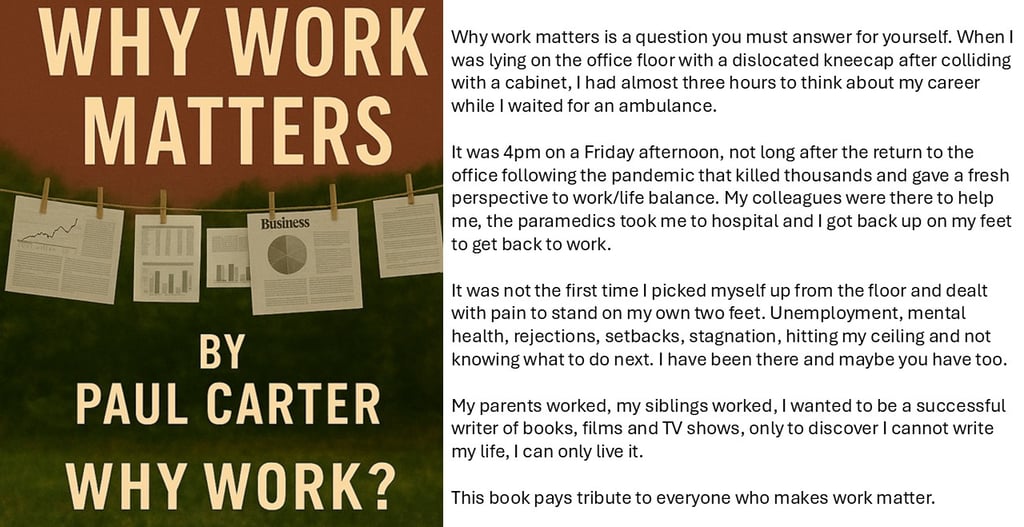
Why Work Matters
FOREWORD
I am pegging clothes on the washing line on a spring day in April. It’s warm enough to wear a t-shirt, but not warm enough to dry my clothes by the end of the day. My work phone is in my pocket. If someone calls for urgent HR advice, I will drop my trousers and pants to answer it. While I like to joke, I take my job seriously of making work matter and helping you believe it.
People need my skills, knowledge and critical thinking. To uphold values, operate strategically and apply employee policies to the complexities of the workplace and real life. Navigating human and organisational strengths and failings to earn a salary and affirmation I am good at what I do. I deserve to be here. To sit around the big table in meeting rooms. To have a voice and listen to yours to get everyone talking, filtering out 99 percent of it to find the story of what we do and why.
When I am on the clock, I protect organisations from legal and reputational risk and instil humanity in corporate visions. That is what I keep telling myself as I hit my mid-forties, my peak earning years. If I am going to spend a third of my life working, I must focus on how to fulfil my potential before time runs out.
My undulating career was more down than up until I entered the people profession. I came alive and discovered instead of moaning about work and bad bosses, I can write and talk about it. I believe in the world of work, not a world without work. Waking up every day to exercise your brain is essential to our wellbeing and ideally the economy.
Finding the right job and career path is difficult. Like my leaning washing line, you can’t stop spinning around, missing the helping hands that could help you. I remember what it was like to be unemployed and unemployable. Now I am misunderstood, unable to control my desire to be a storyteller, even if it is not a must have skill. It’s all about strategy. Soon after my dad died I went running with a friend who was made redundant after losing out to colleagues who demonstrated greater strategic thinking. Who needs explanations, when “strategy” does all the heavy lifting?
The pegs I am using for my ‘I’m with someone strategic” t-shirt, with a big pointy finger pushing other people up the career ladder, snap in my hands. Rubbish, not up to the job. I know that feeling. I have earned the right to write a book about why what you do for a living is more than a conversation starter. It is about you and overcoming the odds and the frustrations to be happy. Everything else is a sideshow that falls away when you keep moving in your career. My strategy formulates in my brain.
My blue sky thinking in a garden I would not be standing in without the bank of mum and dad. I wanted to make them proud even though they always said, ‘A job is a job’. They will never know I achieved my dream of being a writer. A writer with a day job but still a writer. If I did not work and interact with society, I would have nothing to write about.
A BBC WorkLife article on How the workplace became the star of TV suggests there is an audience for why work matters to our lives. If I hang out another sock, I am going to have a mental breakdown. Emails are waiting for me. I will have to unpeg the clothes and hang them on a clothes horse in my lounge, creating a barrier between me and my family. All that time wasted. It’s like being stuck in a Lean thinking experiment in 2007 when every organisation was struggling to understand why their ways of working were increasing waste and reducing productivity. Smarter working to maximise personal time.
What can I do differently to be more effective? I can crouch, grab, jump and peg like a seasonal fruit picker competing with a robot with twenty arms. Too many chores, too little time. The dilemma of a hybrid worker in an overcrowded life who wants it all, but do you deserve it?
I am still a believer in the concept of the workplace, even if you can do your job from home. However, office attendance, caring responsibilities, mental health and neurodiversity are now part of the debate as to the purpose of coming together in offices. Employers are in charge but the what’s in it for me question is waiting for an answer. This book can launch my washing line strategic conversation model to help employers do that.
My debut book explores why we work, the challenges, the good times, mastering your profession and hanging on until you are hung out to dry. Well, that is how you feel; the fear talking, even if it doesn’t mirror what your employer is saying. Everything you did will be forgotten. Your staff pass will be destroyed but everything you did paid for the life you lived. That is what should be treasured as you cash in your ‘I owe you’ to reward yourself and everyone who helped you find meaning from your work.
The camellia and magnolia trees in my garden blossomed while I was writing this book. I was stuck with more whys than an Annie Lennox encore on repeat as I picked up leaves, wondering when frogs would return to my pond. Why am I here? Why am I writing this book? Why should you read it?
The Back to the Future quote from Doc Brown, ‘If you put your mind to it, you can accomplish anything’ is motivational within the confined escapism of a feel-good movie. However, if you are sat in a beige office watching a PowerPoint presentation on how to fulfil your potential, that quote accompanied by pictures of famous people who excelled in their chosen fields, might make you wish Marty McFly travelled back from the future to ensure you read his letter on how to avoid mistakes at work and being killed by disgruntled clients.
Learn the rules and develop the workplace maturity to cope with the rigours of a 50-year career. The transition from adolescence to adulthood and everything it entails will push you and pull while life happens around you. When it’s all over, look over your shoulder to find peace in what you did, why and the impact it had.
My aim is to write a book that people want to read. My intellectual property decorating the pages to paint pictures in your minds. Aspiration, talent, social mobility, discipline, sacrifice, failure, compromise, promotion, success, fulfilment, unemployment and then it’s all over. I’m running out of time to do what I want to do to retire with a smile on my face.
It’s Boxing Day and I am watching episode one of Pluribus, a post-apocalyptic science fiction television series where a virus creates a biological hive to assimilate all humans. To make everyone the same. Before the infection, the main character Carol is a successful author of a hit fantasy romance series. She is miserable because she wants to be a serious author. Her lover and agent Helen responds to her concerns, telling her: “I figure, you make even one person happy? Maybe that's not art. It's something.”
When the world changes, Carol is facing the biggest fight of her life to be herself. That is what we should all strive for. Ideally, under different circumstances.
Inspiration
What we talk about when we are working and living
© 2025. All rights reserved.