BLOGS - PODCASTS - REVIEWS - INTERVIEWS
ABOUT WORK, LIFE AND CULTURE

The Football Business
The Watching Working Living perspective on business-ballers and how football can be a gateway to learning more about the world
Paul Carter
7/18/20264 min read
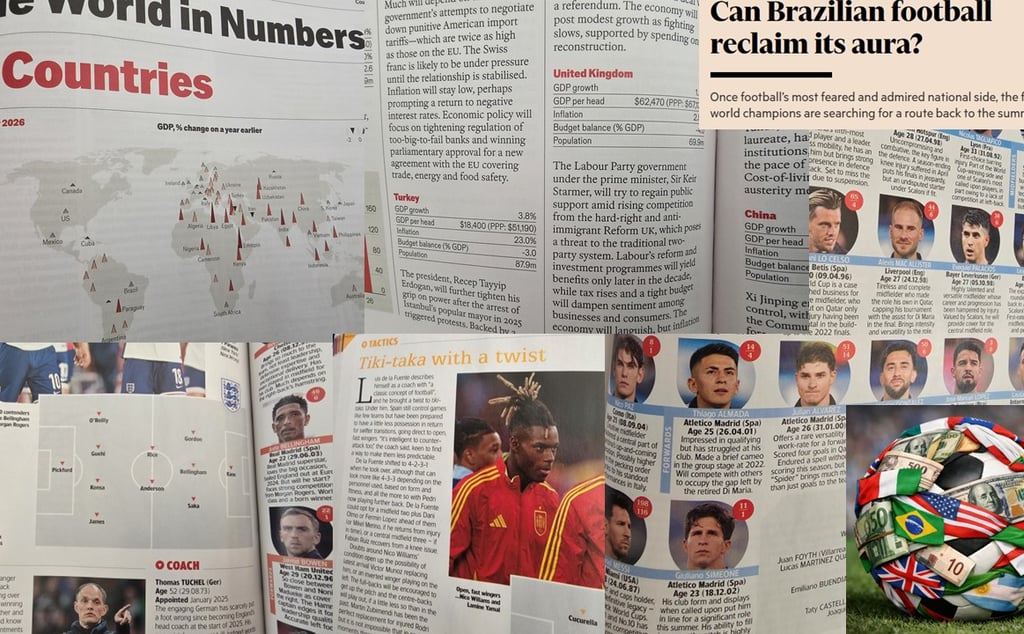
Jude Bellingham is an elite footballer who plays for Real Madrid, the ultimate destination for many footballers. The richest club in the world has appointed Jose Mourinho, the forgotten Special One who was stuck in managerial jobs in Turkey and Portugal until Real Madrid went two seasons without a trophy. The adage ‘never go back’ is forgotten when you need to win to stay at the top. Depending on a past-it Portuguese star to lead a team to glory has become contagious.
Football is a beautiful game driven by the bottom line. The Financial Times argues that modern football is driven by a profit imperative, with clubs, leagues and governing bodies reshaping the sport around commercial optimisation. “Media groups are chasing fans beyond live broadcasts and players are facing ever-heavier workloads. From Brazil’s fading aura to Curaçao’s unlikely rise, football’s old assumptions about power, profit and identity are being redrawn.”
While I fell asleep during some of the World Cup matches, I am becoming increasingly fascinated by the business and political dimensions of football. I always buy the World Soccer Magazine World Cup Guide and The Economist’s World Ahead. Reading the two at the same time gave me a great idea. Football helps you learn about the world. Combining player profiles and teams’ tactics with national economic forecasts, business trends and history would give you something to read while the match happens in the background.
Football can help you understand how the world works. Money, money, money. ‘The amount of money world football's governing body Fifa makes from the World Cup is astronomical,’ reported the BBC. It has been reported that FIFA is predicted to make $13bn over the four-year cycle period. If the World Cup goes from 48 to 62 teams I want historical analysis of how war shaped national boundaries; the economic strengths of countries and cultural differences. Football and business pundits having their say to make it more than a game.
Business Balls
Germany has a Gross Domestic Profit (GDP) per head of $65,260. What does that mean? If you take the total value of everything Germany produces in a year (its GDP) and divide it by the number of people who live there, you get $65,260 per person. It has a population of 83.6 million but, from a footballing perspective, ‘the Nationalmannschaft lacks world-class quality’.
Paraguay eliminated Germany on penalties which has a population of 7.1 million and GDP of $7,490. Its football team defined by toughness, resilience and character. ‘Paraguay's players were an absolute disgrace,’ former England goalkeeper Joe Hart told BBC One. ‘If they were on my team, I'd be dragging them off the pitch.’ As players and managers are representing their countries, bad behaviour should have consequences when it comes to sponsorship, public relations and job opportunities.
While I get annoyed when football pundits, players and fans make tenuous connection to wars, it is interesting to know that Paraguay was a documented haven for Nazi fugitives and was part of the “ratline” escape routes which were clandestine networks using Spain and Italy as transit hubs, with help from sympathetic clergy, corrupt officials and forged documents. These networks moved fugitives to Argentina, Brazil, Chile, and Paraguay.
Talent Talks
Football can be a gateway to history, politics and economics. Gary Lineker and Gary Neville already know this with their business plans very different to David Beckham’s, the UK's first billionaire sportsman. I enjoyed listening to the BBC Business Daily episode The Jude Bellingham brand where I learned how Bellingham and Real Madrid need each other to reach wider audiences and monetise eyeballs in Africa, Asia and America. Jude speaks German, Spanish and English and his devotion to his family is part of his brand to mitigate his bellicose attitude.
It’s not just football clubs that want to snap up early talent. If brands pick a winner before they become an unaffordable superstar, they can profit from their ascendancy. These business-ballers have to perform on the pitch, keep their off-field activities under control and have good people around them. Football is a job and footballers are unlikely to be more interesting than anyone else, even if many think they are gods who grace us with their presence.
I always find the player profiles fascinating as I want everyone’s talent, role and personality to be summarised in 25 words. To understand the contrasting fortunes of footballers, I want to see data-driven player valuation combined with personal brand and image rights value. While respecting the right to privacy, the World Cup is a recruitment fair for footballers who need to cash in on their talent on and off the pitch.
As every country now has or should have a football DNA, I want to see every team publish its vision and DNA. If you cannot conceptualise what your team stands for in a punchy sentence, how can the manager and players do it on the pitch?
Final Thoughts
The 90-minute match may not be the future. Digital platforms are fuelling the rise of short-form football. Newcomers are tearing up conventions and launching faster, condensed games aimed at younger online audiences.
I am getting ready for the World Cup final of Spain v Argentina. Spain has a population of 47.9 million, inflation of 2% and GDP per head of $42,200. Argentina has a population of 46 million, inflation of 18.7% and GDP per head of $12,780. The Economist defines inflation as a general rise in prices across the economy, which reduces the purchasing power of money.
Argentina has the second-largest community of Italians outside of Italy, after Brazil. Jorge Luis Borges stated that "the Argentine is an Italian who speaks Spanish", while the Spanish philosopher Julián Marías stated that Argentina could be ‘the only Italian-Spanish republic on the planet’.
There will always be banter and stereotypes. This is a great moment for Hispanics. Netflix has formally identified Latin America as a “motor estratégico de crecimiento” — a strategic engine for both audience and business growth.
For now, let football do the talking and wave those flags with pride. As for The Falklands, let’s remember all those who died and aim for world peace.
Inspiration
What we talk about when we are working and living
© 2025. All rights reserved.