BLOGS - PODCASTS - REVIEWS - INTERVIEWS
ABOUT WORK, LIFE AND CULTURE

Poo Taboo Splashdown
Let's use the space mission splashdown as a launch pad to end the poo taboo. Our lives and wellbeing depend on it.
Paul Carter
4/12/20263 min read
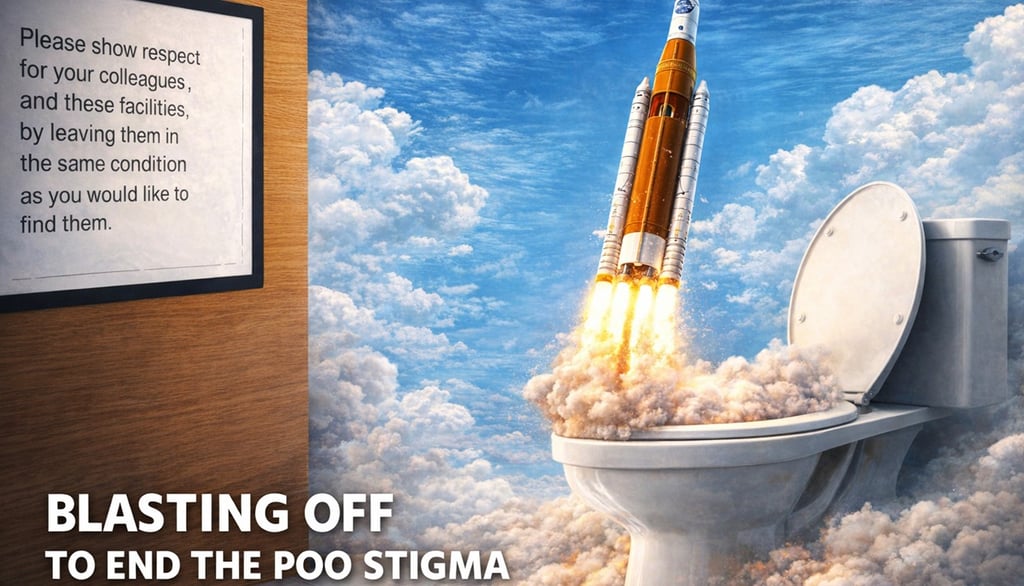

NASA was about to send humans deeper into space than ever before, but the media coverage was flush with news about the Orion space capsule’s dodgy toilet. No number ones and twos, no launch party. The toilet humour gave the Artemis mission a new publicity angle, making it more relatable to everyone back home.
Just imagine being one of the four astronauts on a 10-day mission in a cabin about the size of a camper van, with a blocked toilet producing bad smells, everyone floating around trying to pee in collapsible plastic containers without bumping into each other. Ablutions being the great leveller that unites all living beings and enables us to fly.
The space toilet was unable to dump its waste overboard, possibly due to a frozen or clogged vent line. Solid‑waste disposal still worked, but the system was officially “no‑go” because urine handling was essential for crew safety. Thankfully, engineers on the ground walked the crew through clearing the jam and rebooting the toilet system. The Nutella jar floating across the screen was definitely chocolate spread.
The Artemis crew completed their historic mission to the Moon. In the early hours of 10 April 2026, the capsule landed in the Pacific Ocean for a perfect splashdown. Just dropping some astronauts off at the pool!
End the poo stigma
As a natural storyteller I am turning Orion’s splashdown into a powerful, body‑positive allegory about breaking the stigma around poo, gut health and toilet‑related shame. In space no one can hear you scream. It is time to break the stigma around bowel movements, irritable bowel syndrome, Crohn’s disease, incontinence and the risks that can be detected in our number twos.
Poo is the splashdown of the human body — the natural, necessary end of a process we shouldn’t be embarrassed by. When the Orion capsule hit the sea, the BBC reported: “The mission's moment of maximum jeopardy had passed, and soon the spacecraft's red-and-white parachutes opened and sent the capsule sailing majestically through the sky.” That is how people can feel when they have success on the toilet to free their bodies of waste. Unfortunately, for many, it is an endless battle to release those parachutes.
Shame stops us from seeking help for bowel issues. While it is a private matter, not talking about it can exacerbate poo problems. Employers across the land tackled the mental health stigma to stop people suffering in silence. When people feel unable to talk about bowel needs, they often hold in bowel movements or avoid using workplace toilets. This is linked to: bowel‑movement anxiety, stress‑related gut symptoms and large‑scale studies show that constipation, diarrhoea and bowel leakage are significantly associated with depression.
It’s hard to flush the fear away
If bowel conditions affect day‑to‑day functioning, they may qualify as disabilities under the Equality Act 2010. Employers then have a legal duty to make reasonable adjustments. But if employees feel unable to talk about poo, they never access these rights. HR might have to get comfortable talking about poo-related disorders.
The human instinct of fear is deeply linked to sitting on the toilet because defecation places us in a state of evolutionary vulnerability. Many people fear scrutiny, embarrassment, or being trapped in a public toilet. The fear of being observed or judged combines two potent psychological triggers:
social exposure (fear of being heard, smelled, or watched)
bodily vulnerability
Past experiences can “imprint” fear. Traumatic or embarrassing toilet experiences — especially in childhood — can create long‑lasting fear associations.
Examples include:
being laughed at
being unable to go
painful bowel movements
frightening bathroom environments
These memories can prime the amygdala to treat toilets as a threat, even decades later. The poo taboo is real and affects lives, productivity and the bottom line.
Why this matters
If astronauts can talk about going to the toilet on a mission to the Moon, let’s make it easier for society and organisations to talk about it too. Sometimes it is about shame, sometimes your life depends on it. Bowel cancer is the fourth most common cancer in the UK and kills around 48 people a day. If you detect blood in your poo, it might not be haemorrhoids, so get medical advice.
The splashdown is a launch pad to end the poo stigma and save lives. This is a mission for all of humanity. One small step towards a giant leap for mankind.
When you are using the toilet at work, follow the sign on the back of the door: Please show respect for your colleagues and these facilities, by leaving them in the same condition as you would like to find them.
Inspiration
What we talk about when we are working and living
© 2025. All rights reserved.