BLOGS - PODCASTS - REVIEWS - INTERVIEWS
ABOUT WORK, LIFE AND CULTURE

Maybe I can be a coach
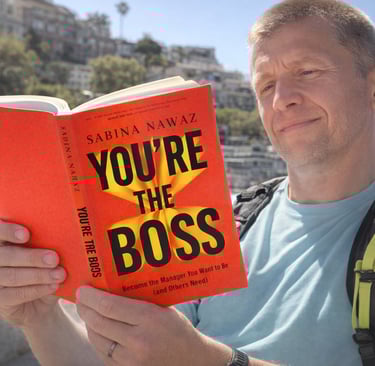
To be a good coach you can't just rely on the art of conversation. You need to read some books on coaching, culture and leadership. Check out my interview with Sabina Nawaz, author of You're the Boss
Paul Carter
3/21/20265 min read

The Harvard referencing system is the closest I have ever come to an ivy league university. I am a writer without a book to my name. I am struggling to secure interviews for the next step up in my HR career. Is my executive presence sliding down the chair. I am not this, I am not that. Do I have what it takes to be a coach? Boring. I spend too much time knocking myself down when I should be celebrating who I am and what I do.
I do not need the manosphere to develop the tools to make myself a success. I wrote and submitted a 7,000-word assignment for my executive coaching assignment while doing a full-time job and finished my first coaching session with a smile on my face. I can do, yes I can, and you can do it too.
I might have competition because everyone aged 45 or older is becoming a coach. Good luck to you all as there may be far more coaches than clients out there. The coach and author I referenced the most in my assignment was Sabina Nawaz and her book You’re the Boss.
Sabina was kind enough to do a Q&A on coaching.
Q) Is earning a living from coaching as difficult as earning a living as an author? Basically, coaching is something you usually do in addition to other paid work, unless you have made it as an elite coach.
For me, coaching as a profession has definitely paid better than being an author. When I made the switch to coaching, I took it on as a full-time job while I’ve written my book, You’re the Boss, as a side job. Also publishing a book requires a lot of investment of time and resources to launch and promote it – time that you’re not usually compensated for.
Q) This extract from your book - "Why would I spend the next five years of my life relentlessly chasing something that I didn’t want?" - most likely resonates with people chasing promotions and career paths they may not want but offer them a livelihood. How can a coach help people make sensible decisions about their career plans and expectations? How do people know when they have reached their limit?
When my clients face a crossroads in their career like I had when I switched from engineering to HR, we work on the fundamentals first: what were their career goals and how might they have shifted? Many discover that they had been on a “should” path vs. a “want” path. What they should do is tied to what those who raised them or the culture they grew up in expected them to pursue – or even what my clients thought they wanted to do at a different stage of their lives.
True, their family wanted my clients to pursue career paths that pay well but simply chasing a career because it might pay the bills is a recipe for boredom, burnout, or worse. By creating a should vs. want list, my clients are able to identify options that are more aligned with where they’re going.
Q) This extract from your book - "A Time Portfolio grounds us so we can achieve our dreams instead of indulging in fantasies." - encourages people to carve out time to do meaningful work that moves them towards their goals. Sounds good in practice but does busyness, social media and declining attention spans make it difficult to change the trajectory of our careers?
We are definitely in an attention-deficit world. This leads to distraction, context switching, and missing the big picture. I was recently at a large conference. It took a long time to get a hotel elevator. One of the reasons for this delay was not because of the large number of people but because of the large number of people who were distracted. People would try to get off on the wrong floor, get on the elevator going up when they wanted to go down, or miss getting off and then push the button or hold the door at the last minute. While these misses are normal from time to time, it was a staggeringly common occurrence. My room was on the 21st floor and there were at least three of four such misses during each trip. And this is just a small example of a bigger issue.
FOMO keeps people tethered to their devices and social media accounts. Managers operating in founder mode and asking for more details than before, keeps employees scurrying. Rapid changes keep all of us disoriented. What do we do when we’re not certain – we cling to what’s right in front of us, what we know is constant – our social streams.
One of the best ways to carve out time for what matters is the first thing in the morning. I don’t mean an hour, I mean one minute. Yes, just one minute. And if that’s too hard, try 10 seconds. If you’ve read my book, You’re the Boss, then you know that I’m a practical minimalist and a fan of micro habits. Most people get on their devices before getting out of bed. In doing so, they have trained themselves and everyone around them to hear from them first thing. What if you were to delay that at first by one minute and then slowly build up to a greater increment?
A client who has done this for nine months now has carved out 20 minutes each morning where he spends 5 minutes with his teenager, does ten deep breaths of meditation, and spends the remaining time tackling the biggest problem of the day.
Q) "The Singular Story means you’re wedded to your version of what’s true and right, and that’s it." - How can a coach help their client to face the fear of letting go of their singular story to understand what it is they want and if this will make them happy?
A coach can simply encourage their client to play. Humans are meaning making machines. So telling us not to make assumptions is about as successful as asking us to defy gravity. Instead, ask people to make even more assumptions. This allows the client to go beyond the first few assumptions and opens up a more expansive mindset. Under pressure, often our first assumption or our Singular Story comes from a place of threat – they are out to get me. By expanding the set of possible meanings, we are able to see more creative ways out of our situation. For example, a client was convinced his peer was tromping on his turf by proposing an agenda item for their boss’s next staff meeting.
When we worked on multiple meanings, my client admitted (reluctantly at first and sheepishly later) that it could be that his peer wasn’t aware he was working in this area, or that he’d proposed the topic to actually help him out. This allowed my client to approach his peer and jointly present the item, resulting in a better funded project.
Inspiration
What we talk about when we are working and living
© 2025. All rights reserved.