BLOGS - PODCASTS - REVIEWS - INTERVIEWS
ABOUT WORK, LIFE AND CULTURE

Executive Coach Reflections
I am determined to make my coaching sessions interesting, fun and rewarding.
Paul Carter
3/1/20264 min read
I am training to be an executive coach, not a counsellor, mentor or self-help guru. Business. Executive. Coaching. Expertise. Credible. Insightful. I can’t fake it until I make it as my clients will see through the sham and pray for the hour-long session to finish so they never have to see me again.
I need to tap into their working life to say something they don’t know which will make them listen to me and value my wisdom. Empowering them to succeed. Easier said than done. While it is tempting to write “but”, it is time to stop making excuses and look for positive connections between goals and outcomes.
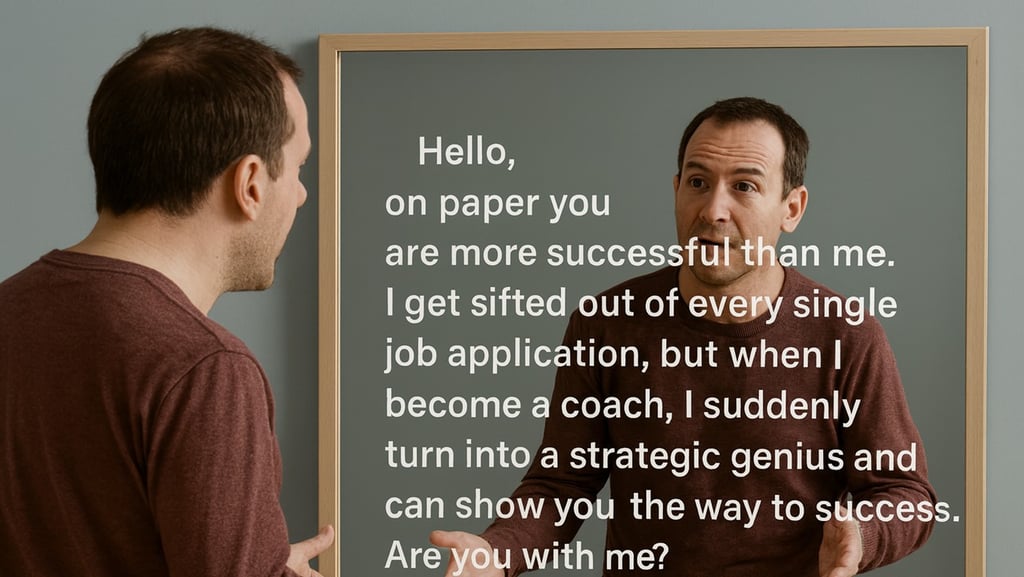
I am practising my introductory speech to clients in front of the mirror: “Hello, on paper you are more successful than me. I get sifted out of every single job application, but when I become a coach, I suddenly turn into a strategic genius and can show you the way to success. Are you with me? Let me hear you!”
Okay, my self-deprecating humour may be a symptom of my adolescent psychodrama; a concept I have been reading about in Leadership Material by Diana Jones. I thought psychodrama was something that politicians said in interviews. However, it is rooted in psychodramatic principles: role, relationship, spontaneity, enactment and the use of lived experience as data.
It sounds a bit woo woo, like something from a Death in Paradise episode or a roleplay acting class. I am not sure if I could incorporate it into my coaching, even though I like the primary aim of enhancing life and relationships by fostering the necessary capabilities for effective, spontaneous and creative functioning. How would it work over Teams? Would my clients lose their internet connection?
I may scoff but I like the underlying theme in this book of how personal experience shapes executive presence. I find the human journey fascinating which is why I want to be an executive coach. “Default behaviours often result from unresolved early family events where our survival was at risk. Old memories and their associated feelings can be triggered by events and relationships in the present day.”
I feel comfortable in that territory, forever lost in teenage psychodrama, even though being an adult is far more fun. I respect people’s boundaries and privacy and agree that “designated titles do not make someone a leader. Leaders emerge when they provide direction in a compelling way and contribute towards goals. When that coincides with a title, people are relieved. When it doesn’t, people are confused and frustrated.”
This book unlocked ideas stuck in my brain for designing effective coaching sessions that reflect leadership roles, the challenges of working in a large organisation, reputation, getting people to do their jobs without falling out and how effort should equal reward. To get my clients talking about their executive presence and the leaders and colleagues in their orbit.
The book identifies three types of leaders
Leaders who understand how they are perceived, both positively and negatively – confident, influential and know how to work effectively with others.
Leaders who focus on how they are perceived negatively – while competent, lack confidence and often stressed – too hard on themselves and lack presence. Downplay their good reputations and ruminate on their own feelings. Lose focus on how they assist those around them.
Leaders who do not care how they are perceived – have their own way of doing things which works for them, perceived as technically able and hard on people.
The profiling might take up five minutes of an hour-long session. I could then move on to how leaders’ capabilities are divided by skills and abilities such as what you do for work and the qualities and capacities that influence how you do it and your impact.
Another 45 minutes to go, I could go back to how default responses come to the forefront when under threat. What if my clients are never under threat or pressure? Maybe stagnation exacerbates overdeveloped default behaviours
“Being vulnerable doesn't mean you have to share your life story. What it does mean is that if you can admit your mistakes and fallibility.” Great, I can talk about behaviours that generate trust in workplaces. The four trust killers are gossip, breaking agreements, not listening or disagreeing, and uninvited and persistent criticism.
But how common is that? What if it kills the conversation? I turn the page and yes, this is what I want, roles and responsibilities, overlaps and gaps. “A gap leads to inaction; an overlap creates duplicate work”. This is more like it. I can make this work. Hang on, if I draw a diagram with people’s names and arrows of how we work together, the call will go dead.
Dammit, I still have another 30 minutes to go. Is psychometrics like callanetics, a no-impact exercise system from the 1980s that uses, small, precise, pulse-like movements to deeply engage muscles and improve posture. That could be a good injection of energy. Why talk when you can squat and lunge.
Coaches must be cool with silence. I will crumble after two seconds. When you can’t talk about football, talk about feedback.
The killer elements of 360 feedback
Rarely personalised
Rarely context related
Overlooks what leader has developed
Too many items
Bosses use it avoid talking directly to staff
Results are filed and not truly confidential
Feedback from managers doesn’t work
Staff don’t respect manager’s perspective – “they don’t understand what I do”
No trusted relationship between manager and staff
Feedback focuses on what is wrong
Feedback is evaluative
Behaviour described ambiguously with long explanations and descriptions
I found a quote for my executive coaching assignment on the fear of crossing the line when giving feedback. “When you consider the costs of staying quiet about your concerns, bring to mind the organisational costs of emotional energy spent navigating around that person, the results not being produced, and your own diverted attention.”
How do I evaluate executive presence? Time’s up.
Inspiration
What we talk about when we are working and living
© 2025. All rights reserved.