BLOGS - PODCASTS - REVIEWS - INTERVIEWS
ABOUT WORK, LIFE AND CULTURE

Book Review: The Alphabet of Happiness
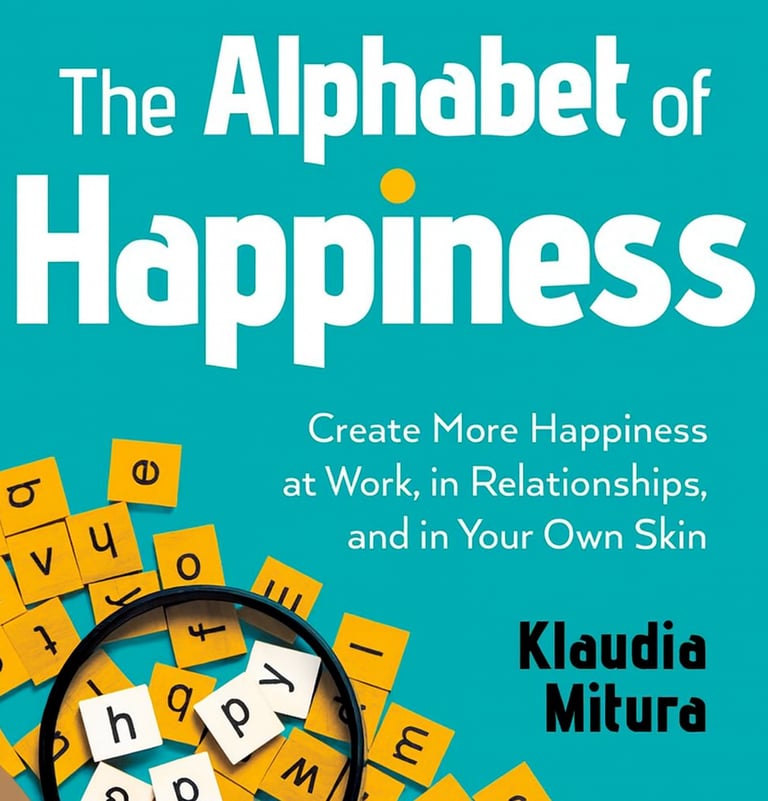
The Alphabet of Happiness written by Klaudia Mitura
Paul Carter
1/28/20264 min read
I am an HR professional struggling to gain promotion, a podcaster struggling to attract 100 listeners and a writer without a book or credits to his name. I was therefore delighted to review The Alphabet of Happiness by Klaudia Mitura, a Chief Happiness Officer working in the people profession, host of the award-winning podcast The Happiness Challenge and now an author.
I’m not bitter as “acceptance is about being open to your thoughts and emotions, not hiding from them or pretending they don’t exist”. No plan survives its first contact with reality are wise words I hear a lot and has spurned several podcasts and books. When I first received this book I feared it might be 26 chapters of A is acceptance, B is for beauty, C is for caring and onwards until you fell asleep before Zzzzz.
While it did follow the format of its titular title, the author is a work psychologist and writes to make us think, using her research to support her perspectives on habits, nature, kindness, social media, uncertainty and finding your X-factor. I liked the section on challenging self-doubt by turning negative concerns into positive statements. “ I am afraid I won’t get that promotion” becomes “I am learning how to present my skills to land a promotion”.
“By acknowledging that you are still growing You admit that you may still have to figure things out, but you also confirm that you are in charge of your happiness and you won't be ruled by your fear.” Life can be scary. The equilibrium does not always give you balance.
I like the theme of resilience running through the book. “When we label events as terrible we assume that we can't be happy, that this should not have happened and that we cannot stand it. We also tend to exaggerate the adversity of events by labelling all adverse events as terrible which does not make sense logically. If losing a job or having a divorce are terrible, what about natural disasters or terminal illness? Where do they sit on the scale? This does not mean that you need to start trivialising difficult life events that happened to you. It is rather about exercising the ability to relax your judgement about certain situations. Acceptance helps to shift the rating from terrible to a little bad… I know that life gets tough sometimes and that's just fine I can deal with it.”
How to use your humour wisely is worth a read. Affiliative humour involves engaging in banter to connect with others. Self-enhancing humour is about laughing at your problems or the absurdity of your tricky situation. Aggressive humour involves being sarcastic and teasing others feel better about yourselves at their expense. Self-defeating humour is about laughing at yourself in front of others so they react more positively towards you. What type of humour do you tend to use? What benefit does it bring you?
Spoiler alert! Klaudia says gratitude is one of the most powerful happiness habits, but she found it difficult to implement. Name three things that you are grateful for today. I could but I am too busy checking LinkedIn for jobs I want but cannot get. I already have a good job and slowly but surely, I am writing a non-fiction book. However I haven’t wrote a TV or film script for a few years and my anthology of running stories is just sitting there.
W is for wonder: stay curious and keep learning. “Remember to look up at the stars, and not down at your feet” is the Stephen Hawking quote to inspire you to have an A to B conversation with your self-esteem and your inner critic can C show itself to the door.
Author Interview - Klaudia Mitura
Q1) What emotions did you experience - the highs, the lows - when writing the book?
As you will grasp from my introduction, the Alphabet of Happiness helped me to find purpose, hope and resilience during a very difficult time in life. So I mainly felt uplifted when writing it, however I also had moments of doubts. My imposter syndrome - I call it "Linda" - was definitely doubting my ability to write a good book about such a vast topic as the science of happiness. I think I tackled it well, but you need to be the judge :)
Q2) How happy did you feel when your book was published? Are you anxious about writing the next book?
At first I was terrified that the book is out there - again Linda was saying that people won't find my book useful. However, the more I started receiving positive reviews, compliments from readers, and attention from the media, I became more and more excited: I wrote a book and it is out there and most importantly, it is helping people! I have a few ideas in my head - I am not anxious of transforming them into a book yet but I am missing the process of writing as at the moment all my free time goes towards promoting The Alphabet of Happiness.
Q3) Should more organisations recruit Chief Happiness Officers? What can they do to show they are essential to the business?
I would say yes, because research is clear; people who are unhappy and disengaged at work are 28% less productive, are 2x more likely to leave, have 55% higher stress levels, are 3x less likely to be creative and finally companies with disengaged employees have 3% lower share price. So ultimately, the role of the Chief Happiness Officer is to prevent these stats coming into play! You can read more about this topic here: https://www.happinessbusinessschool.com/
Q4) How can this book help people who are dissatisfied with their careers?
I actually have a book idea where I dive deeper into this topic :) but The Alphabet of Happiness focuses more on people creating micro-habits that help them to create more happiness and from them make more conscious decisions about their choices. When it comes to work, the book explores such topics as how to stay curious and keep learning at work, how to build self-belief and be an impact player or how to be more innovative.
Q5) Should people include their X factors on their CVs - even if they don't call it their X factor? Would you like to see more personalised job applications / recruitment processes?
Yes, X-factor is about our talents, strengths and traits that make us unique. When I recruit people into business, I often search their application for these as people often shape the role around them. I also often ask in the interview: What would they do first in the role? and What would be their focus? as it often gives me some inclination of what is important to the candidate and what strengths would they apply first.
Inspiration
What we talk about when we are working and living
© 2025. All rights reserved.