BLOGS - PODCASTS - REVIEWS - INTERVIEWS
ABOUT WORK, LIFE AND CULTURE

Book Review: Rebirth of a Nation
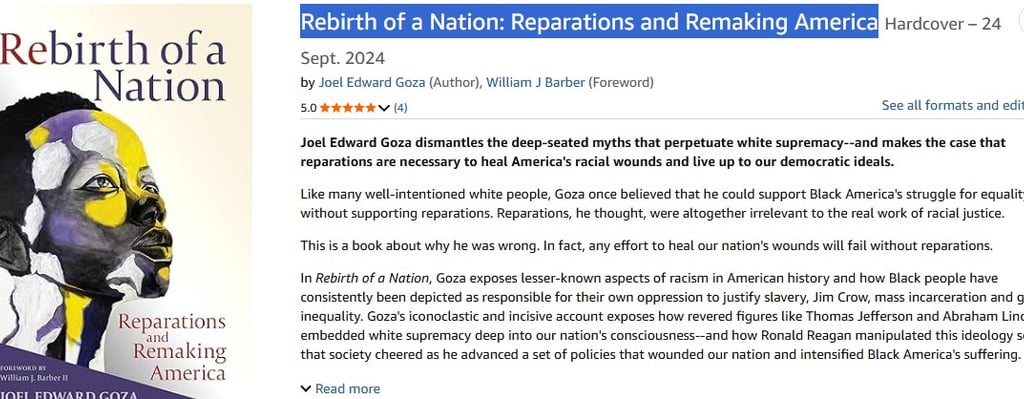
A review of Rebirth of a Nation: Reparations and Remaking America by Joel Goza
Paul Carter
4/9/20263 min read
When people were taking the knee or remaining standing to honour the symbolic gesture of anti-racism after the murder of George Floyd in 2020, I was in team meetings discussing the divisions in society, wondering whether to capitalise the B when referring to Black people. Wanting to do the right thing but not knowing if it was grammatically correct. That seemed more important than if I displayed African artwork in my lounge or whether I knew enough Black people to talk about their experiences with authority.
The murder of George Floyd happened in America. The ripple created waves across the Atlantic in the United Kingdom as we sought to tackle racism in our nation and face our colonial past and the statues and buildings that continue its legacy. It happened during the pandemic, giving me a lot of time to think about stupid things I said or thought when I was younger. This period of reflection combined with watching the racist 1915 film Birth of a Nation at sixth-form college in 1997 gave me the confidence to engage in the continuing debate on racism that shows no signs of abating.
Open a book, open your mind
I believe books are a gateway to self-improvement and greater understanding of the world we live in and the power of words and action. I read Rebirth of a Nation: Reparations and Remaking America by Joel Goza, a white man, who worked in urban redevelopment and community activism for over a decade before focusing on writing. While I am an advocate of enabling more Black authors to reach mainstream audiences, anyone can reflect on the history of racism and write about why it happened.
On Joel’s website you will find the words: Like many well-intentioned white people, Goza once believed that he could support Black America’s struggle for equality without supporting reparations. Reparations, he thought, were altogether irrelevant to the real work of racial justice. This is a book about why he was wrong.
In the UK the police can reveal the ethnicity and nationality of suspects in high-profile crimes to dispel misinformation and prevent risks to public safety such as rising community tension against immigration. If you are interested in how race influences society, this well-researched book on the story of Black people and white supremacy in America should appeal.
The foreword sets the scene for the unfolding chapters on how to deal with America’s racial wounds with dignity, wisdom and grace. Exploring four racial myths on Black sexuality and families, sloth and dependence on handouts, intellectual inferiority and the portrayal of Black men as criminal beasts.
Facing history without self-flagellation
“We cannot imagine a new future without going back and facing the stories that have shaped us into the people we are.”
Relax, this is not an attempt to use history as a progressive form of white self-hate or self-flagellation. It is about self-examination for repentance, restitution, reparations, repayment and repairing America.
Watching a few episodes of Quantum Leap when I was younger helped me understand the Black struggle in America in the 50s and 60s through the many guises of its hero Sam Beckett. But unlike a feel-good TV show, real-life episodes for Black people did not always have a happy ending. Rebirth of a Nation reads like the author has leaped from a difficult time in his life when his “dreams were haunted and nights were often restless” into the lives of impartial observers experiencing slavery, Jim Crow laws and America’s wars on crime and drugs.
Joel tells the stories of people who did not have an audience. Some he witnessed, others he was told, or picked from a long chronology of intolerance and the colours that divide societies. Like many non-fiction books, it is about him, the country he lives in and the country he wants to change, in the knowledge it will never be perfect. When reading it and acting on it, I must be careful to avoid being a white saviour.
Hope, Hopeful, Hoping
W.E.B Du Bois described Black hope as “a hope not hopeless but unhopeful”. Howard Thurman wrote of a “despairing hope and groping faith”. Joel says that with heavy hearts, Black thinkers and activists have hoped against hope that America can be reborn and rid of anti-Black racism.
The most hope I see is in the opening line of emails I receive. While I advocate for the end of all racism, this book is about Black people in America. The evolution of white supremacy in making America, Thomas Jefferson’s role in developing the ideology of racial superiority and inferiority, and the mass rape of Black slave women are all eye-opening insights. I found the presidential chapters the most intriguing from Abraham Lincoln to Richard Nixon and Ronald Reagan.
Joel has the talent to construct historical narrative into compelling social commentary. A professional passion project that deserves reading and reviewing, not a passion-driven rant that friends and relatives pretend to read and give five star reviews on Amazon.
“Until we learn to imagine how different our nation’s past could have been, we will be ill equipped to imagine how different our future can be. The truth is that our racial and economic ways can change, but those changes must be envisioned before they can be actualised.”
Inspiration
What we talk about when we are working and living
© 2025. All rights reserved.