BLOGS - PODCASTS - REVIEWS - INTERVIEWS
ABOUT WORK, LIFE AND CULTURE

Book Review: Lost in Automatic Translation
Book review of Lost in Automatic Translation - Navigating Life in English in the Age of Language Technologies by Vered Shwartz
Paul Carter
5/22/20263 min read
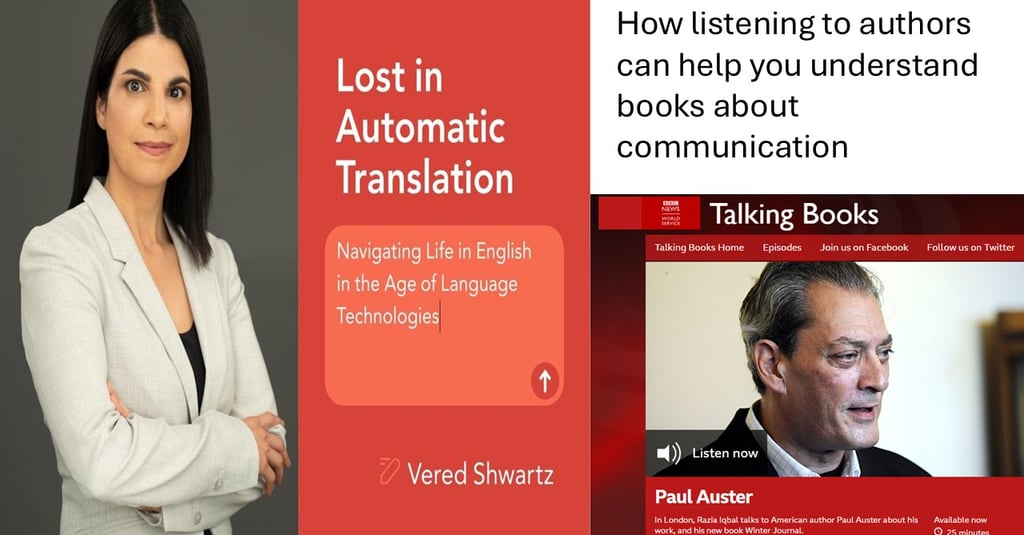
I am reviewing Lost in Automatic Translation by Vered Shwartz while listening to BBC’s interview with the late American author Paul Auster whose books have been translated into more than 30 languages and his New York trilogy was based on identity and annihilation of identity.
It feels apt to reference both as I felt a connection between a book on human communication and the impact technology has on linguistics and understanding one another. In the BBC interview Auster said: ‘All artists are damaged people; we’re the people for whom the world is not enough. Artists have to create other worlds. Who would want to spend 50 years of a lifetime sitting alone in a room. Most people don’t want to do this, but writers do.’
I related to what Auster was saying about identity, escapism and wanting to be understood. Vered Shwartz in a non-native English speaker living in an English-speaking country. This is not grammar self-congratulatory reflections from an “alien” in the USA, which would have been justified after an immigration officer corrected her syntax when she arrived from Israel for an internship at Google.
Don’t give up on learning languages
Vered explores the history of translations from books, analogue and the ongoing development of AI language translation models. It made me wonder if human interpreters and translators will be obsolete by the end of the year. ‘Blindly relying on automatic translation can cause embarrassment and misunderstanding. For this reason, automatic translation doesn’t yet make second language acquisition obsolete.’
I am learning Spanish but would struggle to converse with a Spanish kids at nursery school. ‘Mastering a second language means being able to think in that language rather than translating your thoughts from your native language. The language of our thoughts affects our word choice and grammatical constructions, so going through another language might result in incorrect or unnatural sentences.’
It is a rather technical book that would most likely interest people with a passion for communication, especially if you faced the challenge of learning to live and communicate in English speaking countries. I am glad that English is not a gendered language in the same way that French, Italian and Spanish are. I was interested about how the bias in machine learning models reflect cultural realities, texts and models that reinforce stereotypes.
‘Human languages are efficient, so what goes without saying is often implied. We omit details the listener or reader can infer.’ Reading about how large language models can provide acceptable definitions for most common compound nouns reminded me of homeschooling during the pandemic when I could not help my young children with their English.
I am not particularly academic or articulate often struggling to find the right words to convey my thoughts, settling for basic sentences like prototype computer voices from 1995. But that doesn't stop me from writing and talking and doing everything I can to give other people a voice. This book has heart and a peppering of translation gaffes like mistaking “butt dial” for “booty call”, “hand job” instead of “manual labour” and “blow job” instead of “blow dry”. Sex is everywhere, literally! There are pages on hanky panky, synonyms for genitalia and banana and eggplant emojis.
AI Seduction
I am not that interested in the technological aspect of language translation as I find humans more interesting than technology and facts like: ‘More than 7,000 languages are spoken in the world today, but there are fewer than 200 countries.’ However, there are interesting insights about the darker side of AI chatbots. Bing tried to convince a New York Times journalist that he was unhappy in his marriage and should leave his wife for Ms Bing. I can see that happening more in the future.
‘Whether consciously or not, foreign accents evoke stereotypes and prejudice. This is also true for regional and dialectal accents within American English or British English.’ I expect this will always be the case even though you know it isn’t real. Unfortunately humans are very judgmental.
It was encouraging to read that linguists will not judge speakers for using fillers as linguistics is concerned with studying how the language is spoken rather than how it “should” be spoken. However, research suggests that speakers who use filler words excessively are considered less credible. Too many fillers can be annoying but talking is difficult and effective communication is a skill and everything possible should be done to give everyone a voice if they are worth hearing.
There is a chapter on language and identity. Again I am more interested in the factors that affect the speed or level of forgetting one’s native language than how big tech manipulates our identities. There are some good lines for students to borrow like: ‘Language technologies will not make language learning obsolete, but they can aid us in the process of language learning.’ Just remember to critically analyse the text and what Paul Auster said about writers.
Inspiration
What we talk about when we are working and living
© 2025. All rights reserved.