BLOGS - PODCASTS - REVIEWS - INTERVIEWS
ABOUT WORK, LIFE AND CULTURE

Book Review: Listening Without Agenda
A review of Listening Without Agenda: Practical Steps for Effective Listening by Andrew McMasters
Paul Carter
7/1/20263 min read
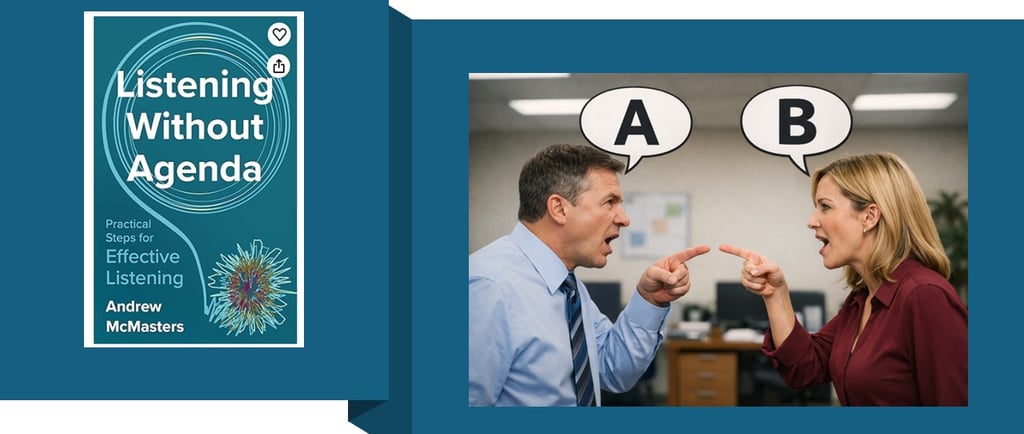
As the book I am reviewing is called Listening Without Agenda: Practical Steps for Effective Listening, I thought it wise to review the audio book rather than depend on the written word. The first time I have done this, and it is not easy. I am listening while working, emptying the dishwasher, doing my physiotherapy exercises. Damn, what did the author Andrew McMasters say?
Hang on, everything is about moments, highlights, eyeballs and ears. I just need enough takeaways to prove that I heard what he was saying and what it made me think. I recognise Andrew’s voice and am busy wondering if he earns money as a voiceover artist for audiobooks. Damn again, I missed what he was saying. As Andrew is an actor, I am expecting his book to be full of profanities as actors love swearing when they do not have a script.
That is an unfair judgment based on other actor interviews I have groaned at, making me doubt their talent. It isn’t representative of Andrew. You listen through your own lens when interacting with others, based on your upbringing, knowledge and status. As Andrew spoke about biases and frames of reference to characterise others, I remembered my helicopter view of work meetings and social interactions when people say their own thing in loosely related conversations.
Talk to the hand, I'm not listening
Andrew talks about a coaching session with a client who was distracted by his phone and busy work life. He was so busy not listening he could not tell Andrew what they discussed during the session which is wasting both their time. I have been accused of interrupting people when all I wanted to do was join the conversation. My mind can wander which is why I take notes when I am talking to clients in my coaching course. They are giving me their time and deserve my attention, ideas and expertise. This is why I listen, let them talk and send written summaries of our sessions to prove I heard what they said and care.
Andrew’s references to committee, governance and business meetings where everyone is too busy to listen might ring a few bells. This is not a criticism of people with important jobs fighting for airtime. I liked the concept of letting people empty their talk buckets, because they are not going to stop talking and start listening until they have had their say.
Instead of the "sell me this pen" test to check if people have the gift of the gab, Andrew has a feel a pen in your hand trick for people to stay present and listen. Actually, I use that trick when I am coaching. When I was younger I always needed to be playing with something to control my nerves. It just made me look more nervous and no one took me seriously. Now I use a pen to write notes and stay focused and have the confidence to make jokes.
What did you say?
When I am having a difficult conversation with someone determined to get their own way, I will try Andrew’s tactic of keeping my head still while talking in a steady rhythm to unbalance my opponent. The other acting exercises Andrew recommends remind me of the A&B acting scene in The Sopranos which ends with someone getting punched on the nose.
I find it easier to talk and maintain eye contact with people I don’t know as they do not know me. I don’t know why I am like that. Maybe I cannot handle the closeness of the human connection. This book made me realise I am shouting into the void on LinkedIn as it is a business networking site for self-satisfaction. It is not a website for listening or building your creative passions.
I laughed at Andrew’s witty comment about the downfall of having a master’s degree in fine arts when he was launching a business. I remember the predicament of finishing university with a journalism degree and realising I was not good enough to be a journalist and not qualified to do anything else.
Do this, then that
This is a book about what happens in our heads and other people’s when we are talking and listening. We don’t see the whole scene; we reconstruct the rest. I would have liked a chapter on when are people worth listening to and when they should be ignored. A big part of listening is not being swayed or manipulated by others, making you doubt yourself. It’s about intelligence, self-awareness and determination to face the fear, live with the risks and do it.
Andrew talks about curiosity which is a trending leadership skill. Asking why, a willingness to learn from others and questioning everything you see can help you understand the environment you are operating in. Like Andrew, I am not an expert at anything and learn every day. People might think I am staring out the window or daydreaming. Sometimes I am but I am always listening.
You don’t need to know all the answers or be ashamed of failure. Know when to listen, ask questions, say nothing or say everything.
Inspiration
What we talk about when we are working and living
© 2025. All rights reserved.