BLOGS - PODCASTS - REVIEWS - INTERVIEWS
ABOUT WORK, LIFE AND CULTURE

Book Review: Daily Practice of Inclusive Leaders
A review of Daily Practices of Inclusive Leaders: A Guide to Building a Culture of Belonging by the authors Eddie Pate and Jonathan Stutz
Paul Carter
4/18/20263 min read

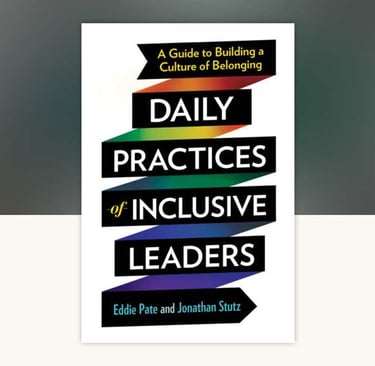
When reading Daily Practices of Inclusive Leaders: A Guide to Building a Culture of Belonging by Eddie Pate and Jonathan Stutz, it reminded me of the comedy series Twenty Twenty Six which parodies the world of work.
The actor Hugh Bonneville embodies the quintessential bumbling Brit abroad, dropped into America as the newly minted Director of Integrity for the upcoming FIFA World Cup. He speaks fluent corporate jargon but remains, at heart, a man simply trying to do the right thing, especially when it comes to inclusion, diversity and equity (ID&E)
In a promotional interview for the series, Hugh said: “There’s no difference between comedy and drama. Comedic characters don’t know they’re in a comedy. If it shows, you're not doing it right. Life is serious. Even when it’s farcical. Which let’s face it, most of it is.”
This soundbite resonated because of the mixed reception that ID&E receives in society and organisations. The authors of this book are writing about the American workplace experience, recognising the state of affairs in their country which are present around the world to varying degrees. The final page concludes with:
“We all could lose any hope for cultures of belonging, for equity and social justice, for dismantling institutionalized discrimination and oppression. This may sound overly dramatic, but we strongly believe that hope is being threatened. Period. Our final challenge then is for all of us to have a dilemma that sparks action, to rock boats and rock them hard, and to not only push accountability out to others but compassionately and courageously face these attacks on what we do and who we are.”
Rock the Boat
If you can rock the boat in your organisation without laughing, backing down or feeling embarrassed, you understand why being an inclusive leader matters. But you have to know how to strategically rock it.
“As a leader, you are a role model, and your people are watching and hearing you all the time - your voice, your body language, your eye contact, your tone, and the words you choose - whether in the hallway, on Zoom, in one-on-one meetings, in staff meetings, or in your emails. If you spend time with kids, you know they’re watching your actions as much as or more than your words. They see everything - all your conscious and unconscious behaviours. They see you. The same goes for your team members.”
To continue the TV show comparisons, I was watching HBO’s Succession and heard the “I see you” statement which can be used to empathise with people, seeing life from their perspective, not from yours. However, Succession converts inclusion statements into underlying threats. This book understands the shades of human psychology and how they unfold at work through interactions, recruitment decisions and the visible and invisible cultural tenets. I liked the message that “leaders must evolve their knowledge and intelligence (book smarts) into wisdom (street smarts).”
Dropping Pebbles
It is not about being nice or being a diversity militant which terrifies and repels people. It’s about dropping pebbles of inclusion into the water to create a ripple in the culture which causes other employees to drop pebbles. Eventually the ripples become a wave of systemic cultural change that rocks the boat. If the wave is strong enough, it might even knock some employees out of the boat.
If organisations combine systems and critical thinking with ID&E, the pebbles can create a bridge for everyone to do the conga over to utopia. If only if it was that simple. As I work in HR I read the chapter on the HR function as an ID&E partner with interest, particularly this paragraph:
“There is an erroneous belief that HR professionals, by nature of being HR, are automatically ID&E subject-matter experts as they embark on their careers. This assumption has prevented many organizations from appropriately leveraging HR to scale ID&E efforts globally.”
I agree with their recommendation that HR professionals should be trained to analyse diversity data to create irrefutable, and at times eye-popping, arguments about what trends are telling us.
Key Takeaway
If you are going to remember one thing about this book, make it the Platinum Rule which is to treat others how they want to be treated, not how you want to be treated. Obviously, this depends on how people want to be treated and how it affects the employment relationship. I expect we have all worked with people who want to do nothing and be paid for it.
Can you manage difficult people and situations in an inclusive way? Reading this book can help you make a plan. Maybe it is lacking a chapter on broaching those awkward topics to challenge perceptions and help you say the right things without being closed down.
You can find out more about the book by watching these podcasts with the author Jonathan Stutz https://globaldiversitypartners.net/podcast/
Inspiration
What we talk about when we are working and living
© 2025. All rights reserved.