BLOGS - PODCASTS - REVIEWS - INTERVIEWS
ABOUT WORK, LIFE AND CULTURE

Believe in the Grieve
The Employment Rights Act is opening the doors for bereavement-friendly workplaces. How can we bring the policies to life?
Paul Carter
5/5/20263 min read
Living and working after a bereavement is a hot topic. How long do you grieve? What does grief feel like? When is the grief over? How many days should you have off work? Maybe it depends on the circumstances of the bereavement. Elderly parents are going to die. You should not have to bury your children but some people do. Any loss, human or animal, can hurt. Sometimes it doesn't hurt as much as you think it will. Other times, death can tear you apart.
Roughly 150,000–170,000 people die each day worldwide. It might be a stretch to get time off work for all those deaths. The Times’ article What my dad’s death taught me about grief in the workplace explored how the British workplace culture still treats grief as a private matter, something to be “managed” outside working hours.
As I cancelled my subscription to The Times, I used Copilot to summarise the article to reflect on the key points. Colleagues saying “I’m sorry for your loss” is far better than awkward avoidance. However, it is your loss, not theirs, so do not expect an all-staff announcement about your bereavement to recognise this difficult time in your life. Some people will want to talk about it, for others it is a private matter.
Managers need to understand that grief shows up in behaviour, not just tears. The only time I have ever cried at work was after my mum died. I was told to stop using her death as an open ticket for getting away with not doing my job. My unforgivable crimes included being two hours late for work because I had to look after my baby daughter. This meant an unimportant intranet article was not published until after lunch. Apparently, it was my wife’s responsibility to look after the children so I could be a man and go to work.
For a second I felt guilty about being late for work and thought the instruction that “work comes first” made sense. A prototype of the manosphere, I can count my happy memories from that role on one finger. My parents and family have given me a lifetime of memories with more still to come. My career was in a far better place when my dad died. I worked for an organisation, manager and team that cared.
The Times references subtle workplace impacts of bereavement: reduced cognitive bandwidth, irritability or emotional flatness, difficulty prioritising, sudden waves of sadness and changes in motivation. That can happen without a bereavement but death of a loved one can make work feel unimportant while also motivating you to succeed in your career.
When you lose your parents, “zero fucks given” rises from their ashes. I am my work and I am extremely ambitious. My parents saw me hold down a permanent job, build a career and earn above the average salary, but it feels impossible to get ahead.
I referred to the hellish administration of death in a job application to demonstrate my interpersonal skills and critical thinking. If life were a movie, I would have got the job. In real life, I did not even get an interview. Two years later, his estate still has not been settled and we are in dispute with an unnamed energy company. My lived experience of death has made me a better person and HR professional. I accept what must be, must be, refusing to get upset about countless job rejections. I will be the person I want to be.
If you make it past 60 years old, whatever time you have after that is a blessing. Just live long enough to retire, spend your pension and leave some money for your family or good causes. I won’t think about work on my death bed. I’ll be thinking about the books, screenplays and blogs I didn’t write, the podcasts I didn’t record and the money I did not make.
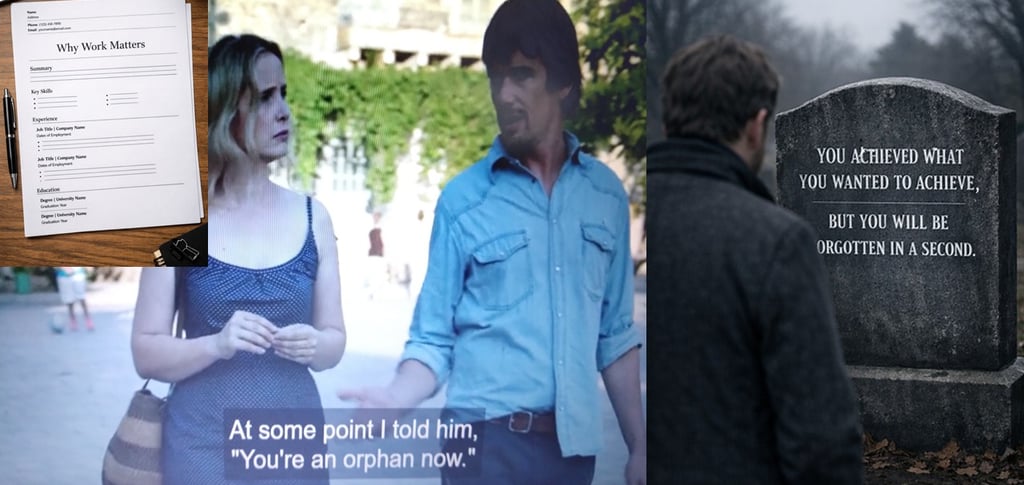
After my dad died in early 2024, I watched the film Before Midnight. Ethan Hawke’s character Jesse is walking with his wife Celine, reflecting on his conversation with his dad after the death of his grandmother.
JESSE: I told him 'Hey Dad, you're an orphan now.' He didn't think that was funny.
CELINE: No, it's not funny at all.
JESSE: Yeah, I guess not.
CELINE: He's next, then you.
I am next in line but am not ready for the sun to go down on me yet. Maybe I have another 30 years, or 10, or my fate has already been decided. I loved these wise words from the medical drama The Pitt. There are four things you should say to someone on their deathbed: “I love you. Thank you. I forgive you. Please forgive me.”
“You made a difference” would be a great addition.
Inspiration
What we talk about when we are working and living
© 2025. All rights reserved.